Approach
The thinking behind the advice.
Every engagement draws on the Strategic Marketing Value System®, a discipline for leading marketing as a source of enterprise value, built to stand up at board level.
It connects marketing decisions to growth, margin, capital allocation and long-term value, so that marketing’s contribution can be defined, directed and judged with the same discipline as any other significant business investment.
Whether you lead the whole marketing function or a brand, portfolio or division, it shows how your work creates value, and how that value should be recognised.

Why it exists
Marketing shapes more of the enterprise than it is credited with.
Marketing influences which customers a business serves, the markets it competes in, what it offers, how it is positioned and why it is chosen. Few functions touch more of what creates enterprise value.
Yet in many organisations it is still budgeted as a cost, judged on its activity and brought in after the strategic decisions have been made. Marketing leaders feel it in budget rounds, in how their teams are judged and in how rarely their contribution is fully recognised. The Strategic Marketing Value System® was developed to close that gap.
Marketing is managed as a cost to control, and is often the first budget cut.
Investment is committed against a stated case and an expected return, and reviewed against what it delivered.
Its influence on strategy falls short of its reach across customers, markets, portfolio, brand and competitive position.
Six value drivers put that reach at the centre of strategic choices, judged on both customer and commercial value.
Its value is rarely expressed in the terms the business uses to judge performance.
Marketing’s contribution is agreed with leadership in the business’s own measures: revenue, margin, customer value and competitive position.
Activity metrics stand in for evidence of value.
Operational signals are kept separate from commercial evidence, so each is used for the decision it can support.
People cannot see how their work connects to the goals that matter, so good work goes unrecognised.
Every role has a line of sight from its own measures to the business goal it serves, so its contribution is visible and credited.
Course corrections come late, once results are already missed.
Thresholds for action are agreed before money is spent, and evidence is reviewed at the level where the decision sits.
Recognise any of these in your organisation?
What holds it together
Three principles run through every part of the approach.
The pillars are not separate steps. They are the tests every part of the approach has to pass, from the business’s goals down to a single campaign.
Value defines what counts. Strategic judgement decides how it will be created. Governance makes sure it is directed, owned and checked. Take any one away and marketing slips back into activity that is hard to defend.
Value
What counts as value here, and who agrees it?
Value is defined commercially, in terms of customer impact and sustainable, profitable growth, and shared by marketing and the leadership it answers to.
Where you see it: the business’s goals, the agreed marketing contribution and the commercial evidence used to judge it.
Strategic judgement
Are we making the choices that create that value?
Commercial thinking and foresight, applied at every level: weighing evidence, options and trade-offs, from enterprise direction to individual campaigns.
Where you see it: where to compete and how to win, the investment case behind each strategy, and what is deliberately not done.
Governance
Is it owned, directed and held to account?
Marketing is aligned with how the business is governed, with clear decision rights, visible contribution and course correction before results are missed.
Where you see it: decision rights, role contribution cards, thresholds for action agreed in advance and regular steering.
How it is structured
Four layers, from business intent to market action
The layers put the principles into practice, moving from what the enterprise is here to achieve to the action that creates it.
Strategic foundation
What is the enterprise here to achieve?
Business purpose, board intent and commercial goals, within the enterprise’s guardrails for governance, risk, ethics and financial stewardship.
Strategic value drivers
Where does value come from, and how does each driver change the others?
Every driver is judged on customer value and commercial value. Neither lasts without the other.
Value creation engine
What judgements must we make, and what will we invest?
Activation
How do the choices become coordinated market action?
A go-to-market plan for each strategy, with campaigns, experience and activity measured as signals of value, not as success in themselves. Performance evidence feeds back into strategic steering.
At its heart
The Commercial Value Cascade
Goals and targets cascade down. Evidence rolls back up. Every measure connects to the goals the business is judged on, and every role can see where its contribution lands.
Every measure must explain a measure at the level above. If it does not, it is activity, not evidence.
Optimisation improves execution against the targets that have been set, at levels 5 to 7.
Strategic steering runs across the whole cascade, monitoring the evidence and re-evaluating goals and direction where needed. Thresholds are agreed before money is spent: if we see this, we do that.
A click-through rate is a signal at level 7. It is never evidence at level 1.
For every role
The role contribution card
Each accountable role completes one. It shows what the role contributes, how that connects to the target above, and how the contribution will be judged.
Whether you lead the function or a single brand, it is how your contribution becomes visible, and is credited for what it delivers.
The first three rows are the commitment. The last four are how it is run. If a role cannot complete the first row, its work is not yet connected to value.
See it in practice
The thinking made visible
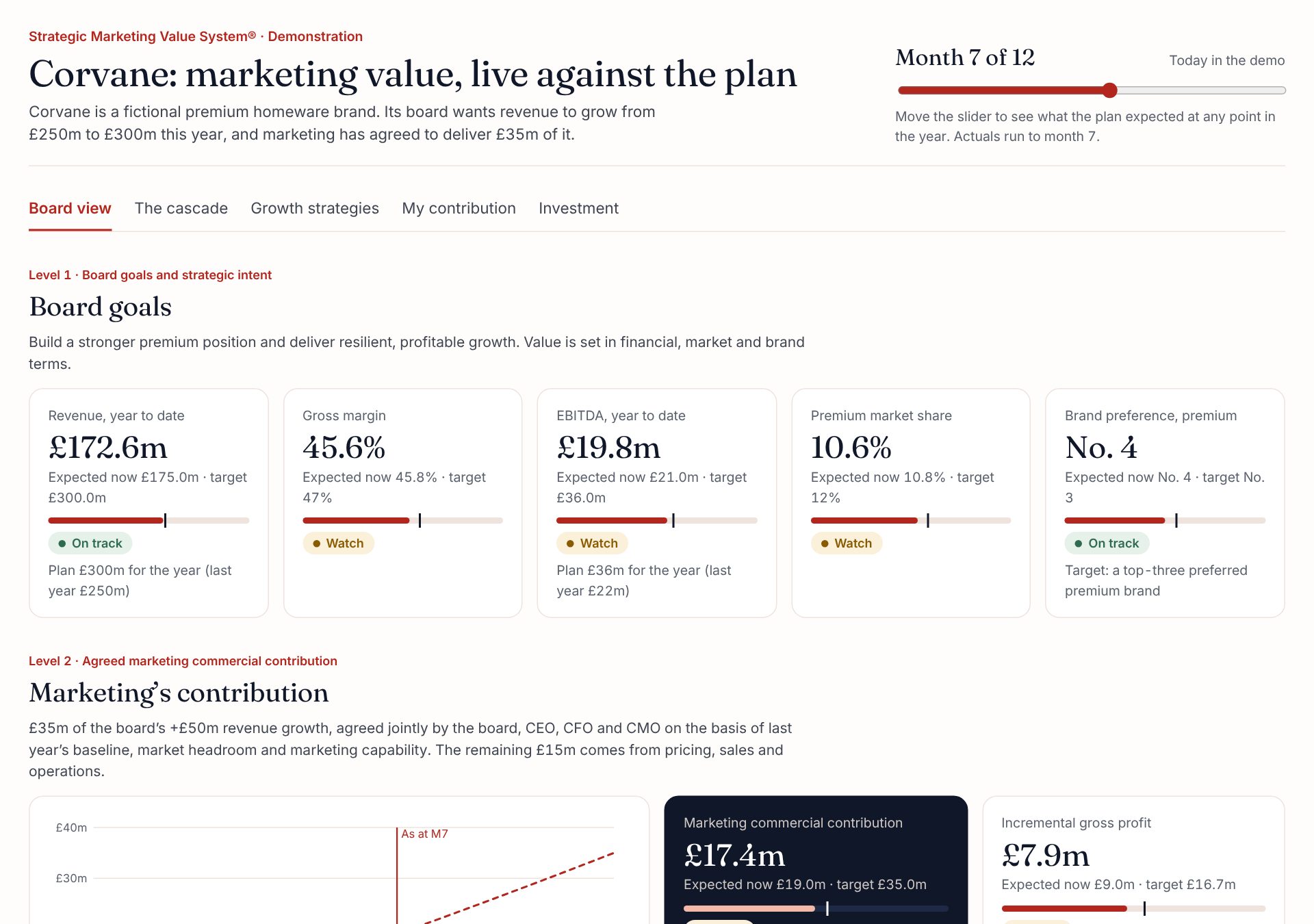
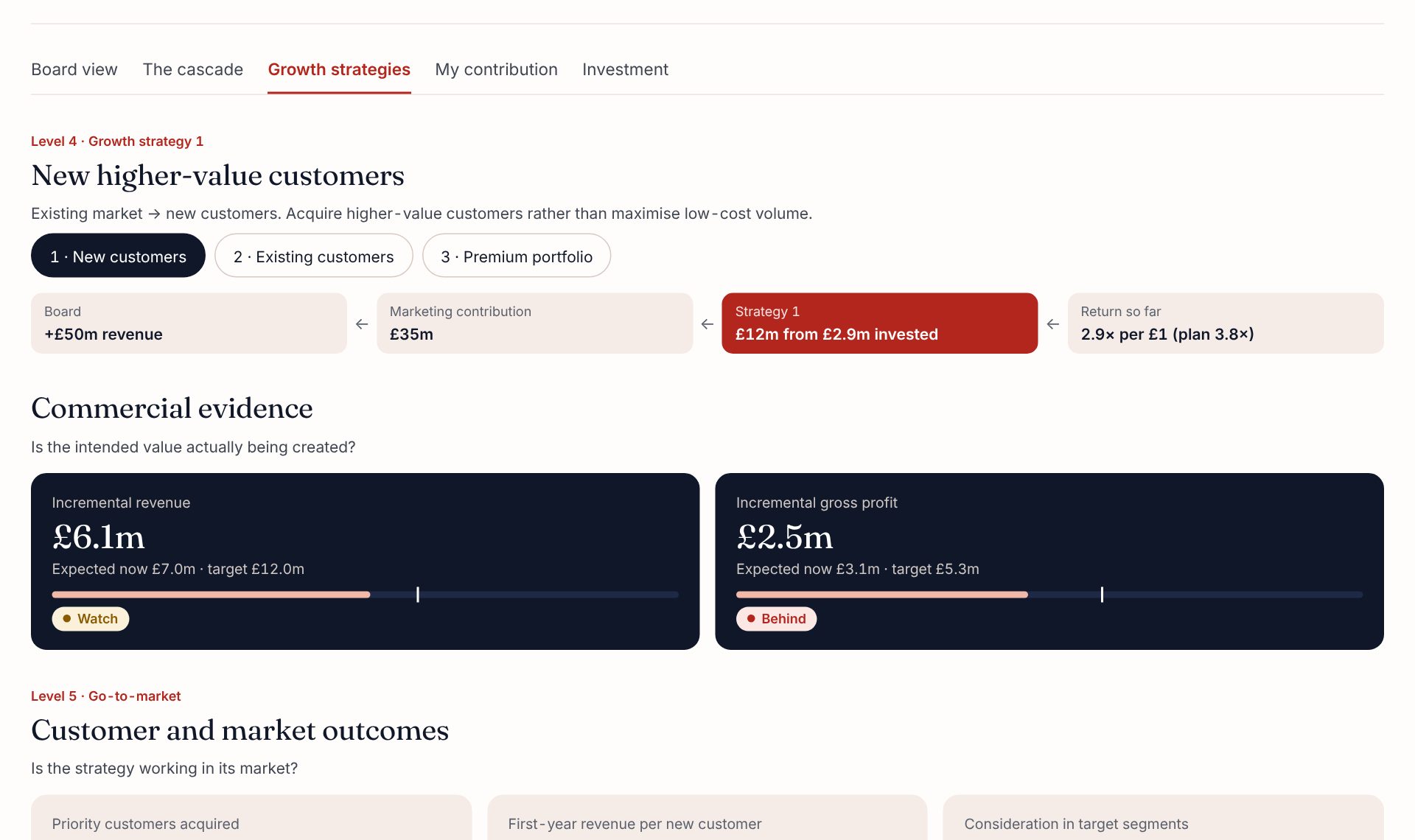
As part of the Marketing Value Programme, the cascade can be set up as a dashboard for your marketing leadership team, so you can see at any point whether marketing is delivering what was agreed, where it is falling short and what to do about it.
It brings together board goals, marketing’s agreed contribution, each growth strategy, every role’s commitment and the investment decisions behind them, updated as evidence comes in.
The walkthrough follows a fictional premium brand to month seven of its year, including the moments where the operational signals and the commercial evidence disagree, and the decisions that follow.
Walkthroughs are given personally, so they can be shaped around the challenges you are working on.
What it means for you
This discipline is why the advice holds up.
You come for help with a plan, a budget, a decision or the way marketing is led, not to adopt a framework. This discipline is what makes that advice go further.
Advice drawn from experience alone can be insightful but hard to defend. Because every recommendation is worked through it, it is tied to the commercial goals your business already uses, tested against the evidence and clear about the assumptions it depends on. That is what lets it stand up in front of the people who fund and judge your work, and keep working after the engagement ends.
Strategic Decision Session
When one important moment is coming up.
The same tests are brought to a single decision: is it tied to a goal that matters, what is it assuming, and what would change your mind? You leave with a clear next step.
Strategic Review
When you need an independent view of a plan, budget or investment case before it is committed.
Your proposal is tested for its link to a commercial goal, the return it implies, the assumptions it rests on and what should prompt a change of course. You come away knowing where it is strong, where it is exposed and what to fix, in terms your board will recognise.
Leadership Sounding Board
When you want a trusted, independent voice on the decisions and pressures of your role.
The conversation stays on the choices that matter most at your level, separating the signals that call for adjustment from the evidence that calls for a decision. Your thinking becomes sharper, and easier to defend.
Marketing Value Programme
When a leadership team wants to change how marketing is led, funded or judged.
Elements of the method are built into your own planning and reporting, such as an agreed contribution, clear lines of sight and thresholds for action agreed in advance. Adapted to how your organisation already works, the discipline stays with you once the engagement ends.
You do not need to adopt the method, or even use its language, to benefit from it.
Strategic Marketing Value System® is a registered trade mark and SMVS™ is a trade mark of Dr Karen Hanvik. The Strategic Marketing Value System, the Commercial Value Cascade, the role contribution card and related materials © 2026 Dr Karen Hanvik. All rights reserved.